
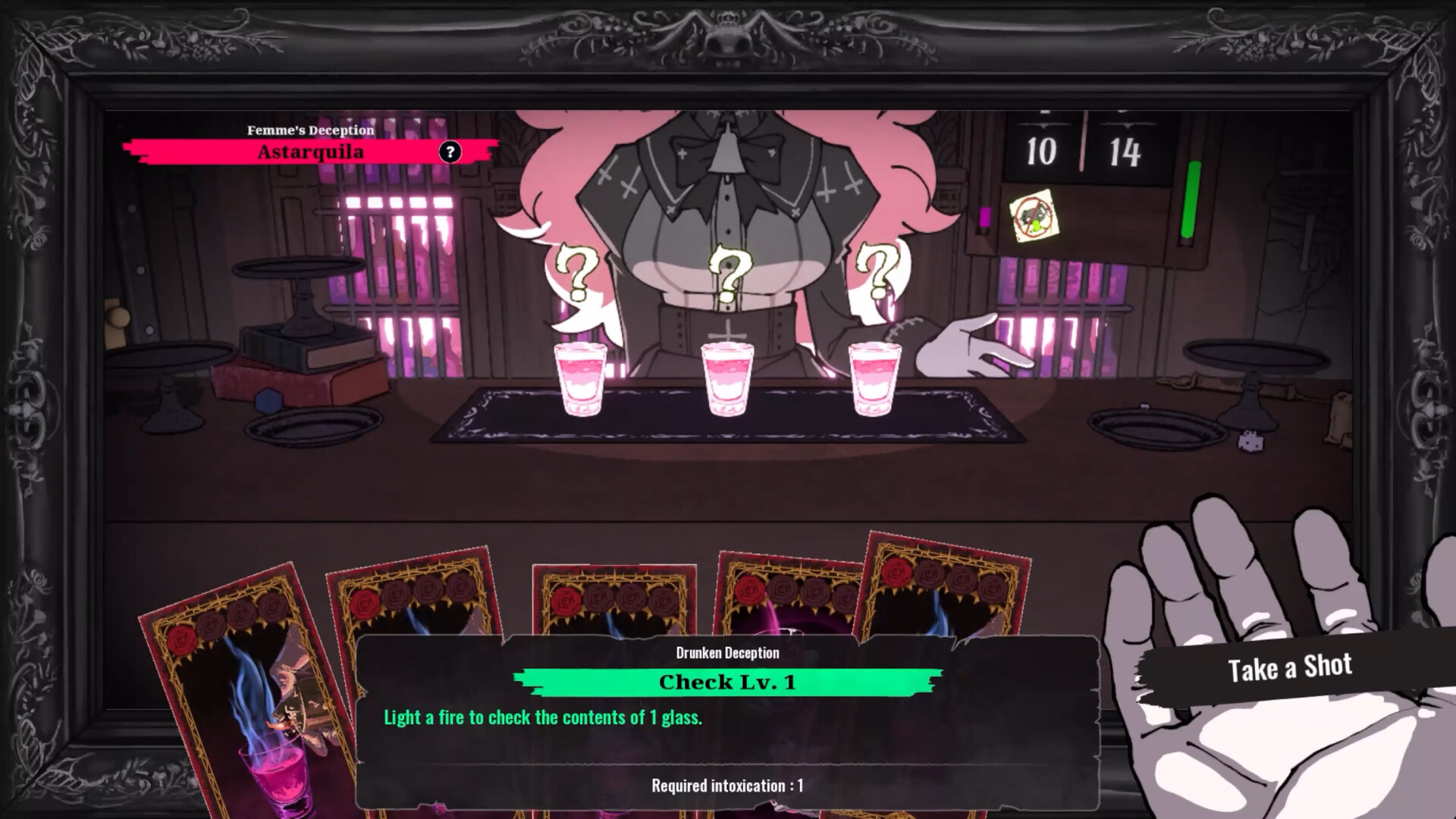
Both sides of the table play cards. Yours are called Drunken Deceptions, they sit in a fan at the bottom of the screen, and every one of them has a price printed on it that is not money.
The price is intoxication. A card shown in the released footage reads Check Lv.1 — light a fire to check the contents of 1 glass, with required intoxication: 1 underneath. You cannot play it sober. That single line explains the whole game's design philosophy: the state that is killing you is the state that gives you options.
What a deception does
The cards fall into four broad jobs, and recognising which job a card is doing is most of the skill in a hand.
Information. Check is the clean example. You spend intoxication to learn what is in a glass before you commit to it. In a game where the bottles carry visible values and hidden contents, that is the difference between picking blind and picking on purpose.
Economy. Some cards change what a round pays. Femme's Triple is the model: coins gained and used are tripled, which is either a gift or a trap depending on which side of the transaction you are on when it lands.
Interference. Cards that go after the other player's side of the table rather than your own. Femme's Astarquila is one of hers, and the banner system is honest enough to tell you the name of the thing that just happened to you.
Self-harm. The ice pick. The studio has described driving it into your own hand to use the pain as a shock that clears your head, and improvised surgery that replaces a damaged hand with something built from bar tools.
That last category is the one people repeat when they describe this game, and it is worth being precise about why it exists. It is not gore for its own sake. It is the only way to buy intoxication back down, and the currency you pay is your health. Sobering up is a purchase like any other, and the game makes you do it with a tool you would not choose.
Levels and requirements
Cards are levelled. Check is level one. Higher-level deceptions presumably do more and cost more, though no card above level one has been shown.
The requirement line is the interesting part. If a card needs intoxication level three, then the sequence of a run is partly decided for you: you cannot open with your best tool, you have to climb to it, and every step of that climb is a drink you did not want.
This is a neat inversion of the usual deck-builder economy. In most games of this shape, resources let you survive longer. Here, surviving longer is what produces the resource, and the resource is also the timer.
When to hold and when to spend
Three heuristics, drawn from the systems rather than from playing the build:
Spend before a rule change, not after. A card that triples coins used turns your saved stack into a liability. If you are holding coins when Femme's economy card lands, you are paying triple for the same effect.
Buy information on the round you intend to win. Check costs intoxication, which is the thing you are rationing. Spending it on a round where the pool is small is a waste; spending it on a round with a 9 in the row is how you convert a good pool into a good result.
Keep one sobering card in hand. The ice pick exists because the meter does not go down on its own. A player who spends every card for value and never buys clarity will lose to their own intoxication counter, not to Femme.
What the deck is not
It is not a hand you draw from in the collectible sense — at least not visibly. The footage shows a fixed fan of cards at the bottom of the screen with coins as the stated cost, and no draw or discard animation has been released.
It is also not symmetrical. Femme plays from her own set, and her cards are announced as hers: the corner label reads Femme's Deception before the card name. That asymmetry is deliberate. You are not playing the same game as her; you are playing against a dealer with a house deck.
Where the tricks come from
The store copy mentions other patrons at Pandemonium who teach you sneaky skills that tilt the odds. Pandemonium is a bar with regulars, and the implication is that the player's deck grows by meeting them rather than by unlocking a tree.
How that works — whether patrons are a shop, a progression gate or a story beat — has not been shown. What has been shown is that the deck is small enough to fit on one screen, which argues against a hundred-card collection and in favour of a dozen cards you learn properly.
Questions people ask about the cards
Can you play cards without drinking?
No. Every deception shown so far has an intoxication requirement, and Check's is level one. The cards are gated behind the state you are trying to avoid.
Is the ice pick a card or an item?
It has been described by the studio as a trick you can pull, alongside improvised hand surgery, both of which buy back clarity at a cost to your health. Whether it lives in the card fan or in a separate action slot has not been shown.
Does Femme Soule have her own cards?
Yes. Her deceptions appear under a Femme's Deception label, and at least two have names: Triple, which triples coins gained and used, and Astarquila.
How many cards are there?
Not published. The hand visible in the footage is five cards wide, which is a long way from a hundred-card set.
The one thing to understand
Drunken Deceptions make the drinking legible. Without them the game would be a guessing contest with a hangover attached. With them, every glass becomes a calculation: what does this cost me, what does it unlock, and can I still afford the card that saves me if the next round goes wrong.
The answer is usually no. That is the game.