
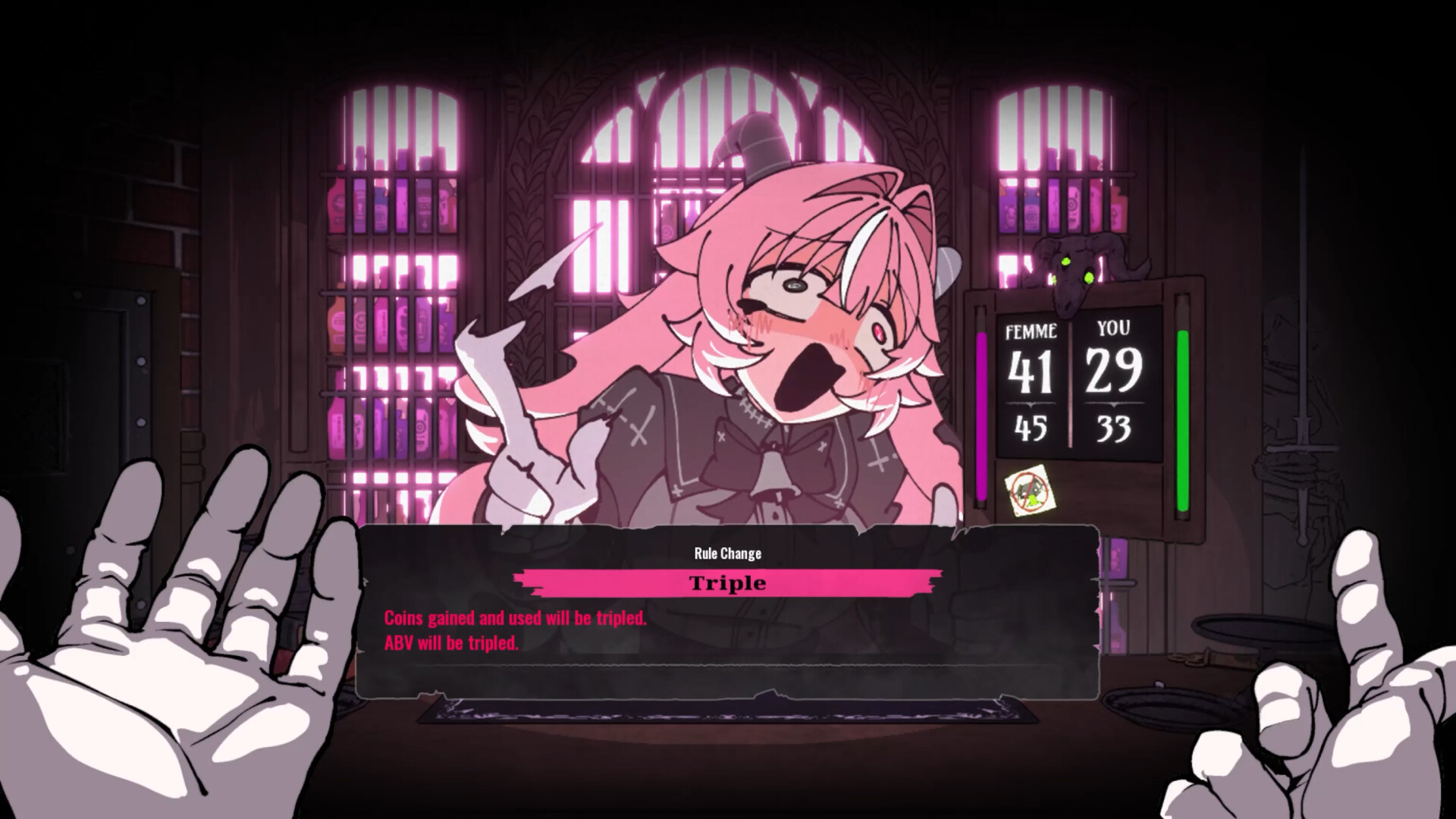
Femme Soule runs Pandemonium, the bar at the bottom of Hell. She is the demon of alcohol, she has been behind that counter alone long enough to have developed opinions about it, and she has decided that you would be happier staying with her than going back to your life.
The store describes her as a demon who would kill for you — or kill you. That line is doing a lot of work in a short space, and it is the most accurate summary of the character available: she is not cruel, she is in love, and in this setting those are not different things.
The name
Femme Soule reads as French. Femme is woman. Soule is one letter and one accent away from soûle, the feminine form of drunk.
That is not a coincidence in a game called Drunken Goddess Reflux, and it is not subtle either. The demon of alcohol is named Drunk Woman, in French, with the accent filed off so it reads as a surname. Players who search for her without the accent — femme sol, fam sour — are typing something close to what the developers actually meant.
Her regional name matters too. In the Japanese build the game is titled Pukey Goddess Shot Trick, and the character keeps the same name in Latin script — ファム・スール in katakana. There is no separate Japanese name to learn for her, which is one less thing to hold in your head than the title itself will demand.
Chinese is the exception. The store there gives her 梵·醺儿 — a two-character adaptation rather than a transliteration, where the second character 醺 means tipsy. It is the same kind of move as the French pun: name the demon after the state she stands for.
What she wants
Most antagonists in this genre want something you have. Femme Soule wants something for you, which is worse.
Her position, as the store copy presents it, is that you are desperate to escape reality and would be happier living with her in Hell. She is not lying about the first part. The game starts from the assumption that a person playing a game about drinking away an evening has some distance from their life, and she builds her whole argument on it.
She proposes the contest as a way to settle the question. Win, and you go back. Lose, and she gets the eternity she was asking for. From her side that is a fair bet offered in good faith — she is confident you will lose, but she is not cheating to make it happen.
That is the interesting part of the characterisation. A villain who wants to trap you is a monster. A villain who genuinely believes she is offering you a better life is a person, and the game's tone depends on that distinction holding.
What she does at the table
Femme is not a passive opponent waiting for you to fail. She plays from her own deck, and her cards are announced as hers.
The corner of the screen carries a label reading Femme's Deception before the card name, and each one rewrites a rule. Triple triples coins gained and used. Astarquila is another, with its effect and name shown the same way.
So she is the game's rule engine as well as its antagonist. Every mechanical surprise in a run — the banner that drops mid-round telling you the economy just changed — is her doing, attributable to a named card she chose to play. That is a much better design than a random event table, because it lets you learn her.
Over enough runs you should be able to read her patterns the way you read a blackjack dealer's up card. The material released so far does not show whether her deck cycles predictably, but the naming system strongly implies it is meant to be learned rather than endured.
What she is not
She is not a monster with a human face, and she is not a victim. Both readings are available from the premise and both would flatten her.
The store copy is careful about this: she would kill for you, or kill you, and the sentence does not rank the two. Everything she does at the table is legal within the game she proposed. She keeps to the rules until her cards let her change them, and changing the rules is itself part of the game.
That is a rare thing to get right in a one-opponent title. A villain who cheats is a difficulty spike. A villain who plays her own deck honestly is a character you can lose to without feeling cheated.
The design
She is drawn in a hand-inked 2.5D style: pink hair with a white streak, curled horns, a corset over a high-collared shirt with cross-stitch detailing, and a mismatched pair of eyes — one of which reads as a ring or spiral rather than a pupil.
The animation budget has clearly gone into her rather than the environment. The background is a static painted bar with a few lighting states; she is the thing that moves, and the expressions carry the tone.
That is also why the character design is the content rating's problem. The outfit and the framing are aimed at a specific audience, and the Steam tags reflect it. The page on age ratings covers what that does and does not mean in practice.
Questions people ask about her
Who voices Femme Soule?
Nanahira, credited as the game's voice. Japanese is the only full voice track, so every other language hears her performance with subtitles.
What does the name Femme Soule mean?
It reads as French for drunk woman — femme plus soûle with the accent dropped. The demon of alcohol is named after the state she represents.
Is she the final boss?
She is the only opponent. There is no dungeon and no gauntlet; the whole game is one contest against her, which makes her both the antagonist and the entire difficulty curve.
Is she evil?
The game's own framing is that she is in love. She offers a wager, she keeps to it, and she intends to honour the outcome either way. Whether that is villainy depends on how you feel about someone deciding what is best for you.
Why she carries the game
A single-opponent game lives or dies on whether that opponent is interesting after twenty runs. Femme Soule is built for that: she talks, she plays cards you can name, she has a stated desire that does not change and a method that does, and she is present in every frame whether or not she is speaking.
The measure of whether it works will be whether players start describing her the way they describe the dealer in a good card game — as a personality with habits, not as a difficulty setting. The naming system is the strongest sign the studio is aiming for exactly that.