
Drunken Goddess Reflux does not have a tutorial problem, it has a pacing problem, and the pacing is the game. Rounds escalate, the numbers on the board climb faster than your understanding of them, and the first night usually ends before you have worked out what any single number means.
This guide is about the first three rounds: what to spend, what to hold, and which mistake is the one that ends runs.
Mistake one: banking coins
The single most common way to lose is to treat coins like a resource to accumulate.
They are not savings. Coins exist to be converted into deceptions, and a stack of unspent coins is a stack of unused options while your intoxication counter climbs toward the thing that kills you. Every round you do not spend is a round Femme gets closer to a rule change you cannot answer.
The board makes this worse on purpose. When her Triple card lands, coins gained and used are tripled. If you were holding a large stack, that rule reads as a threat rather than a gift, because the price of everything you wanted to play just went up by three.
Spend early. Spend on the rounds where the pool is worth winning. The only coin worth holding is the one that buys the card you cannot afford yet.
Mistake two: treating the cheap bottle as the safe one
The three bottles each carry a value, and it is tempting to read the high number as the risky one. It is the opposite.
A round's payout is built from those values together — a row of 9, 1, 1 pays more than a row of 3, 3, 3 — and the bottle you choose determines what you drink, not what you win. Taking the small glass does not protect you. It protects her, because a cheap round means the payout is small for both of you and the intoxication you saved was never the limiting factor.
The correct reading is: the round has a fixed pool, and your job is to take the largest share of it while keeping your lower counter low enough to still play cards. That is a different decision from picking the cheapest glass.
And the cheap glass is not cheap in the way you expect. The contents are hidden even when the values are not. A 1 on the label does not promise a gentle drink.
Mistake three: not reading the corner
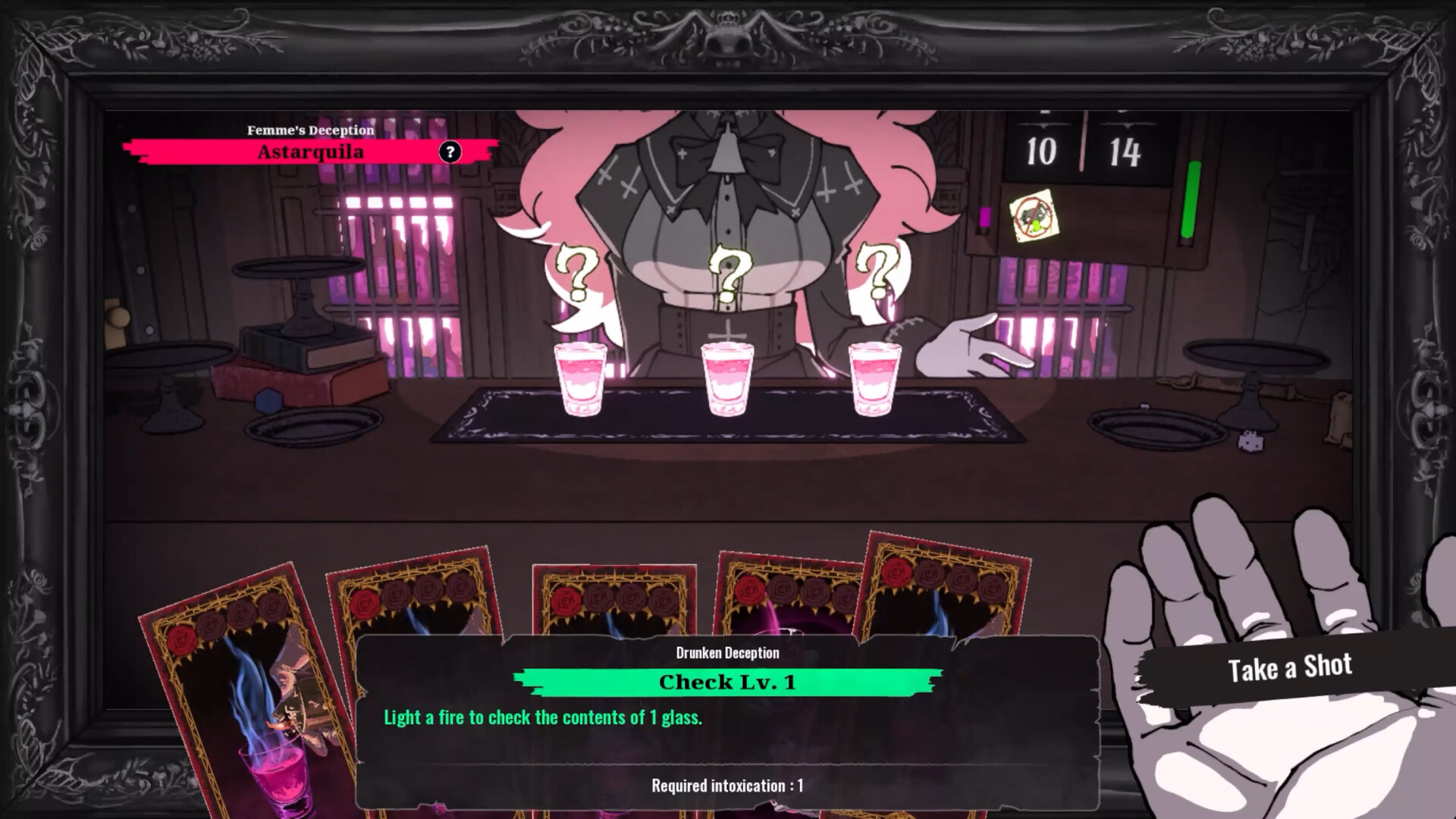
The top-left of the screen tells you which of Femme's deceptions is live. It is a small label, it is easy to ignore while you are looking at bottles, and it is the most important piece of information in the round.
When a rule change fires, a banner drops with the name and a one-line explanation. Watch for the name, because the name is what recurs. Triple will come back. Astarquila will come back. Over enough runs, the name is how you learn what she is about to do rather than what she just did.
Treat that label the way you would treat a dealer's visible card. It does not tell you the future, but it narrows it.
What to do in the first three rounds
A sequence that survives longer than flailing:
- Read the bottle values before anything else. Decide whether this round is worth winning. Small pool, small ambition.
- Play information only when the pool is large. A Check card costs intoxication to learn what is in a glass. Spending it on a 3, 3, 3 row is waste; spending it on a row with a 9 in it is how you convert a good round.
- Spend coins the same round you earn them, unless a specific card is one level away from playable.
- Track your intoxication counter, not your health. Health is a resource you spend on the ice pick. Intoxication is the clock.
- Expect the rule change on the round you are winning. That is when it hurts most, and that is when it will come.
Things the game will not tell you
Three gaps that are worth knowing about before you start.
The scoring formula is not explained. You will see a base score, a type multiplier, a house adjustment and a total. The relationship between the bottle values and the base score is visible in the arithmetic — 9, 1 and 1 producing a base of 11 — but the game does not sit you down and teach it.
The card list is not published. You learn your own deck by drawing it, and you learn hers by being beaten by it.
The length of a night is not stated. The board climbs fast between rounds two and three, which suggests a run is short and the escalation is steep. Plan for a handful of rounds, not twenty.
The mindset that works
This is a game about spending a resource that also happens to be your life bar. Every instinct from a normal roguelite — conserve, upgrade, snowball — points the wrong way here, because the conserving is the losing.
The players who will be good at this are the ones who treat intoxication as ammunition. You are drunk because you are dangerous. You are dangerous because you are drunk. The trick is arranging to be the second thing slightly longer than the first.
Questions beginners ask
Should I take the highest-value bottle every round?
Not automatically. The value decides what the round is worth; the drink decides what it costs you. Take the high bottle when the pool is worth winning and you can still afford a card afterwards.
When should I use the ice pick?
When intoxication is blocking a card you need this round. It buys clarity at a cost to health, so it is an emergency purchase rather than a routine one.
Do I need to learn Femme's cards?
Yes, and the game gives you the tool for it: every one of her deceptions is named on screen. Learning names is the fastest route from reacting to anticipating.
How long does a run take?
Not published. The escalation between the early rounds suggests something closer to a short, sharp session than a long campaign.