
The core of Drunken Goddess Reflux is a Russian roulette played with shot glasses, and the first thing to understand is that the roulette is not the interesting part. The interesting part is what you pay to stay in it.
Each round presents three bottles. They carry numbers you can read and contents you cannot. You pick one, you drink it, and the drink does something to your side of the board. Femme Soule drinks on hers. Rounds continue until one of you loses the contents of their soul rather than their stomach.
The three bottles
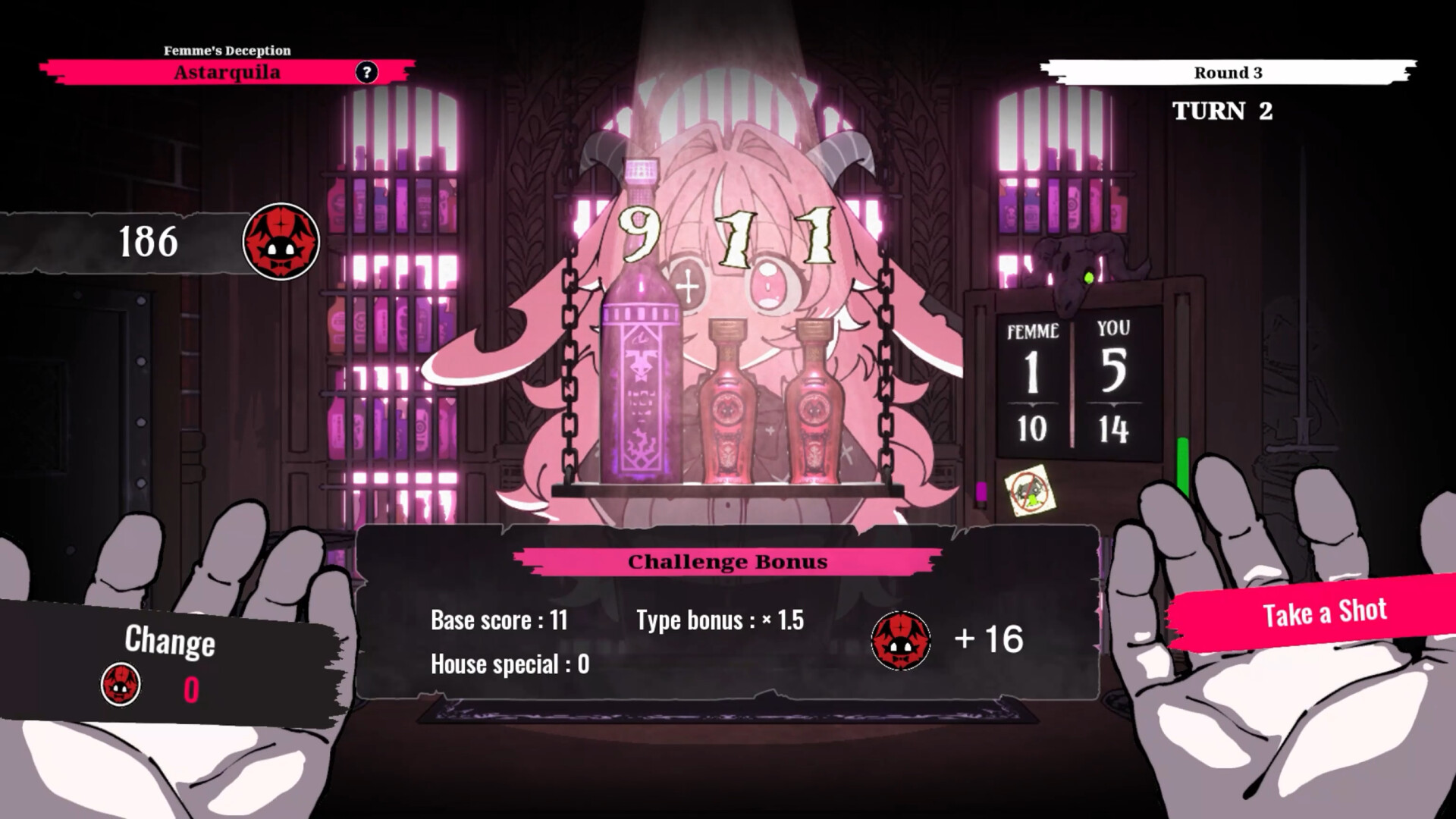
In the footage released so far the bottles are stamped with values — one screenshot shows 9, 1 and 1 lined up behind the bar. The numbers are visible, the liquid is not, and the difference between the three is the entire decision.
The round then resolves as a bonus calculation printed on screen: a base score, a type multiplier, a house adjustment, and a final figure. In the same screenshot the base score is 11 — the sum of the three bottles — the type bonus multiplies it by 1.5, the house special is zero, and the round pays out +16.
Read that carefully and a design intention appears. The three bottles are not three independent gambles; they are one pool, and picking from it converts the pool into a number. A row of 9, 1, 1 is worth more than a row of 3, 3, 3. That means the round's generosity is set before you choose, and your choice is about which part of it you are willing to drink.
The board
Both players get two counters on the scoreboard, stacked one above the other.
The upper number is what you can spend. It grows when a round pays out, and it is what Drunken Deception cards draw on — the Triple rule change, for instance, triples coins both gained and used, which is only a threat if you have coins to use.
The lower number is intoxication, and it only goes one way. It also gates your cards: a Check card shown in one clip requires intoxication level 1 before it can be played, which means the resource that is killing you is the same one that unlocks your options.
Above the board, a round and turn counter. Below it, a running total marked with a skull that decides who is ahead in the night as a whole rather than in the current hand.
Why "drunk" is a mechanic and not a filter
Most games with a drinking theme use intoxication as a screen effect. Here it is closer to a second currency, and the design is built so that the two currencies trade against each other.
Sober, your card selection is limited and your options are narrow, but you keep control of the table. Drunk, cards unlock, the rules bend in your favour, and your ability to read what is happening degrades. The studio's own line for this is that the more you drink, the more the rules break down — and the footage supports it literally, because the rule changes are the thing you are unlocking.
That is the tension the whole game sits on. You cannot win by staying sober, because a sober player never gets access to the tools that beat a demon. You cannot win by drinking freely either, because the meter that gives you those tools is the same meter that ends the night.
Rule changes
Mid-round, a banner drops with a name and a one-line rule. One example: Triple — coins gained and used will be tripled.
The name on that banner matters. It is not a random event. In the corner of the screen the same word appears under a heading reading Femme's Deception, which means the rule change is something she played. Her deck is the weather; your deck is the umbrella.
Each of her deceptions has a name — Triple in one clip, Astarquila in another — and each one rewrites a rule for the rest of the round. You get told what changed and, implicitly, how long you have to live with it. The skill is recognising which of her cards is worth spending against and which one you can simply eat.
What a round actually asks of you
Put together, the loop is shorter than it sounds:
- Read the three bottle values. The pool this round is fixed and visible.
- Decide how much intoxication you are willing to take for that pool.
- Spend coins on a deception, if you have one worth playing at your current level.
- React to whichever deception Femme has live — she is not waiting for you to finish.
- Drink, resolve, and start the next round closer to the edge than you were.
The failure mode for a new player is treating step two as a free choice. It is not. Every round you take the cheap bottle is a round she takes the expensive one, and the board does not reset between hands.
Questions people ask about the rules
Is the roulette random?
Partly. The bottles' contents are hidden, but their values are printed on them, so the round's payout is visible before you commit. The randomness is in which glass costs you what, not in whether the round is worth anything.
How many rounds does a run last?
Not published, and the footage only shows up to round three. The numbers on the board climb fast between those rounds, which suggests a full night is short — closer to a handful of escalating hands than a long campaign.
Can you lose on the first round?
Unlikely by design. The intoxication counter starts low and the cards that matter require levels you do not have yet, which is the shape of a game that expects you to survive long enough to learn its systems.
What are the skull coins for?
Spending. Coins are the cost of playing a deception, and some of Femme's rule changes alter both what you earn and what you pay. Hoarding them is only correct when no card in your hand is playable at your current intoxication.
What is still unknown
The exact scoring formula, the full card list, and whether the bottles' contents are fixed per round or drawn from a pool. None of those have been shown, and guessing at them would produce a page that is wrong in a week.
What is settled is the shape: three numbers, a drink you cannot refuse, two counters that move in opposite directions, and a demon who changes the rules on her own turn.